
Note — This guide is intended for general orientation and does not replace individual professional planning. It is based on typified assumptions and does not take into account the spatial, technical, regulatory and operational conditions of your business. Before making a purchase or installation decision, have all specifications relating to safety, hygiene, fire protection, electrical installations and ventilation checked by a qualified professional, and observe the regulations applicable at your location. For the characteristics of a specific product, only the information on the relevant product page and individually agreed terms are authoritative.
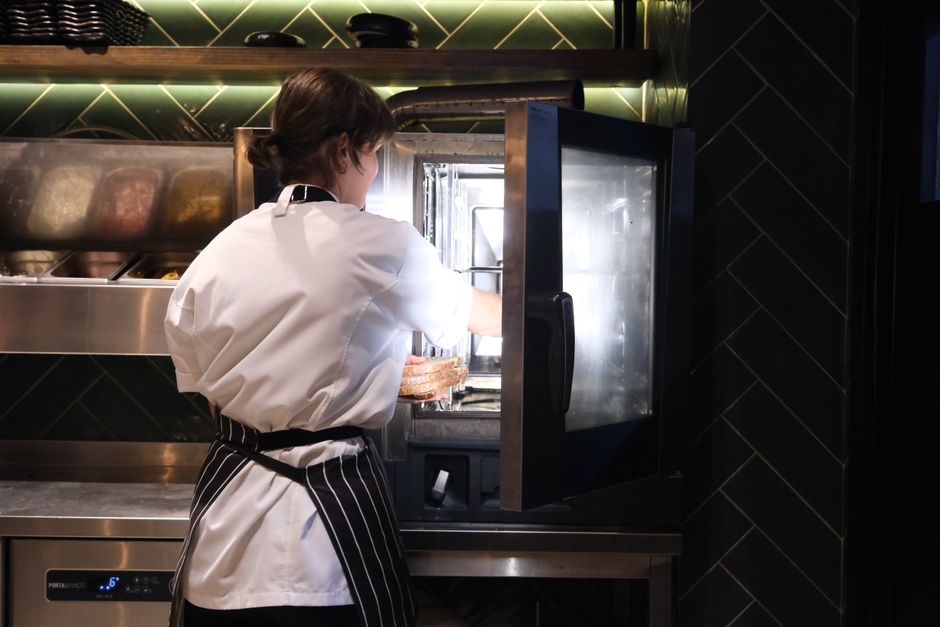
Few appliances define the professional kitchen as strongly as the combi oven. It combines convection heat and steam, taking on roasting, baking, steaming and regeneration – jobs that once required several separate machines.
Combi oven, combi steamer or steam oven – what's the difference? (There isn't one.)
In practice, all three terms mean the same appliance. "Combi steamer" describes the technology from one direction – the combination of steaming and convection heat – while "combi oven" is simply the other common trade name for the same machine. The one distinction that matters is against the pure steamer, which works exclusively with steam: a true combi oven masters convection heat, steam and the combination of both operating modes.
How many trays do I need?
Capacity should follow the number of covers per service, not the size of the kitchen:
- 4 trays (60 x 40 cm): The convection oven with steam function and built-in timer suits smaller operations, bistros, snack bars or works as a second unit – for baked goods in the 60 x 40 cm format, for instance.
- 6 trays (1/1 GN / 60 x 40 cm): The workhorse for mid-sized restaurants. Takes 1/1 GN gastronorm containers and 60 x 40 cm trays alike – an advantage when the kitchen and the patisserie share one machine.
- 10 trays (1/1 GN / 60 x 40 cm): For large-scale kitchens, catering and high throughput, where whole menu lines are produced in parallel.
Rule of thumb: better to plan one shelf level in reserve than to run the machine permanently at its limit.
Analogue or with a timer?
The analogue versions (6 and 10 trays) rely on robust rotary dials for temperature and operating mode – quick to explain, resilient in a hectic service, with no electronics to fail. The 4-tray convection oven additionally brings a built-in timer: set the cooking time, wait for the signal, done. For standardised workflows, that is a real gain in process reliability.
What to look for when buying: power supply, standard sizes, maintenance
- Electrical supply: the 6- and 10-tray units run on 400 V three-phase power. Before ordering, check that a suitable connection exists at the installation site and have it fitted by an electrician.
- Standard sizes: make sure the machine matches your existing container stock. The combination of 1/1 GN and 60 x 40 cm keeps both worlds open.
- Maintenance and cleaning: build daily cleaning of the cooking chamber firmly into your routine and keep the door seals clean – it extends the service life considerably.
You will find our matching combi ovens and convection ovens in the range below.
More guides for your commercial kitchen
It is also worth a look at our guide to cooking equipment and our guide to commercial fryers.
Matching Products
-
 MaximaYou save 39%2-Year Warranty
Extractor Compact Combi Oven 6X + 10X 1/1 GN
-
 MaximaYou save 39%2-Year Warranty
Extractor Combi Oven 11X 1/1 GN
-
 MaximaYou save 42%2-Year Warranty
Extractor Combi Oven 6/10 X 600 x 400 mm (Smart)
-
 MaximaYou save 40%2-Year Warranty
Extractor Combi Oven 7/11 X 1/1 GN
-
 MaximaYou save 42%2-Year Warranty
Extractor Combi Oven 7/11 X 1/1 GN (Smart)
-
 MaximaYou save 42%2-Year Warranty
Extractor Combi Oven 7X 1/1 GN
-
 MaximaYou save 46%2-Year Warranty
Commercial Combi - Steam Oven - Fits 10 Trays (1/1 GN / 60 x 40 cm) - Analogue - 400 V
-
 MaximaYou save 46%2-Year Warranty
Commercial Combi - Steam Oven - Fits 10 Trays (1/1 GN / 60 x 40 cm) - Digital Display - 400 V
-
 MaximaYou save 40%2-Year Warranty
Commercial Combi - Steam Oven - Fits 4 x 2/3 GN Trays - Analogue
-
 MaximaYou save 40%2-Year Warranty
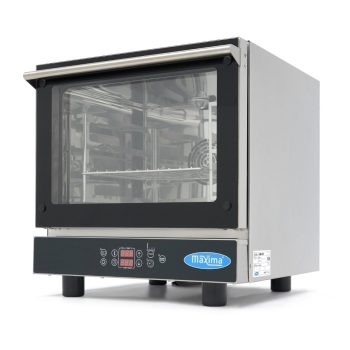
Commercial Combi - Steam Oven - Fits 4 x 2/3 GN Trays - Digital Display
-
 MaximaYou save 44%2-Year Warranty
Commercial Combi - Steam Oven - Fits 5 Trays (1/1 GN / 60 x 40 cm) - Digital Display - 400 V
-
 MaximaYou save 46%2-Year Warranty
Commercial Combi - Steam Oven - Fits 6 Trays (1/1 GN / 60 x 40 cm) - Analogue - 400 V
-
 MaximaYou save 46%2-Year Warranty
Commercial Combi - Steam Oven - Fits 6 Trays (1/1 GN / 60 x 40 cm) - Digital Display - 400 V
-
 MaximaYou save 44%2-Year Warranty
Commercial Combi - Steam Oven - Fits 4 Trays (1/1 GN / 60 x 40 cm) - Analogue - 400 V
-
 MaximaYou save 44%2-Year Warranty
Commercial Combi - Steam Oven - Fits 4 Trays (1/1 GN / 60 x 40 cm) - Digital Display - 400 V