

Note — This guide is intended for general orientation and does not replace individual professional planning. It is based on typified assumptions and does not take into account the spatial, technical, regulatory and operational conditions of your business. Before making a purchase or installation decision, have all specifications relating to safety, hygiene, fire protection, electrical installations and ventilation checked by a qualified professional, and observe the regulations applicable at your location. For the characteristics of a specific product, only the information on the relevant product page and individually agreed terms are authoritative.
In professional catering, the deep fryer is one of the hardest-working appliances of all: chips, fried fish, schnitzel, breaded snacks – often in continuous use for many hours. A professional commercial deep fryer is therefore fundamentally different from a domestic appliance: robust stainless steel construction, considerably higher heating output, large oil volumes and details such as a drain tap for a fast oil change. Our range covers both designs – compact Countertop Fryers for the counter and the snack bar as well as powerful Floor Fryers for the large-scale kitchen. This guide shows what matters when making your choice.
Countertop or floor-standing fryer?
The first fundamental question when buying a fryer for catering use is the design. A countertop fryer stands on the worktop or on a base frame and is suitable for snack bars, food trucks, bistros and as a supplementary appliance in a restaurant kitchen. Capacities here range from compact twin units with 2 x 8 litres up to large single tanks with 30 litres (linked in the table below) – an induction model is also part of the range, which heats up particularly quickly and controls temperature precisely. A floor-standing fryer, by contrast, is a floor-mounted appliance for continuous commercial use: models such as the twin fryer with 2 x 16 litres including stand or the large 45-litre single tank (also in the table) are designed for large-scale kitchens, canteens and fry-heavy concepts in which large quantities are produced continuously. Rule of thumb: anyone frying only a few hours a day works more economically with a countertop unit; anyone for whom frying is a core process needs the capacity and output of a floor-standing fryer.
All sizes compared
The following overview shows a representative selection from our range – from the compact 4-litre entry-level unit to the 45-litre floor fryer. The model name links directly to the product page.
| Model | Oil volume | Baskets | Power | Connection | Price from |
|---|---|---|---|---|---|
| Countertop fryer 4 l | 4 l | 1 | 2,500 W | 230 V | €74.99 |
| Countertop fryer 2× 4 l | 2× 4 l | 2 | 5,000 W | 230 V | €132.81 |
| Countertop fryer 8 l | 8 l | 1 | 3,250 W | 230 V | €93.75 |
| Countertop fryer 2× 8 l | 2× 8 l | 2 | 6,500 W | 230 V | €181.25 |
| Countertop fryer 10 l | 10 l | 1 | 3,000 W | 230 V | €106.25 |
| Countertop fryer 11 l | 11 l | 1 | 3,000 W | 230 V | €118.75 |
| Countertop fryer 2× 11 l | 2× 11 l | 2 | 6,000 W | 230 V | €220.59 |
| Countertop fryer 13 l | 13 l | 1 | 3,000 W | 230 V | €118.75 |
| Countertop fryer 16 l | 16 l | 1 | 3,000 W | 230 V | €118.75 |
| Floor fryer 16 l | 16 l | 1 | 3,000 W | 230 V | €231.25 |
| Floor fryer 30 l | 30 l | 1 | 4,800 W | 400 V | €363.24 |
| Floor fryer 35 l | 35 l | 1 | 6,000 W | 400 V | €386.96 |
| Floor fryer 45 l | 45 l | 1 | 7,500 W | 400 V | €497.17 |
One thing stands out: all countertop fryers up to 16 litres run on 230 V, even as twin units. The step up to 400 V only comes with the larger floor fryers from 30 litres – there the connected load rises considerably, so that large, cold batches also come back up to temperature quickly.
Single or twin fryer?
Whether single or twin tank is decided by your menu. A twin fryer for commercial use has two separate tanks, each with its own basket and its own temperature control. The practical advantage in service: two products can be fried in parallel at different temperatures – chips in one tank and fish in the other, for example, without flavour transfer through the oil. In addition, one tank can be reheated or cleaned while the other keeps running. A large single tank (around 30 or 45 litres with one basket), by contrast, plays to its strengths with large batches of a single product: more connected oil volume means a more stable temperature when a large quantity of food is added at once. For most mixed menus in catering the twin fryer is the more flexible choice; for pure volume production, the large single tank.
230 V or 400 V three-phase power?
In practice the power connection is often the decisive criterion – even before capacity. Plug-and-play 230 V appliances run from a normal (adequately fused) socket and are ready for use immediately: ideal for snack bars, food trucks or sites without a three-phase connection. As the table above shows, even our larger countertop models up to 16 litres are available as a 230 V version. A commercial fryer with three-phase power (400 V), on the other hand, offers considerably more heating output per tank: the oil reaches the target temperature faster and holds it even with large, cold or frozen batches – the most important factor for consistent frying quality during peak trade. A 400 V fryer does, however, require a professionally installed three-phase connection (CEE). So check before ordering which connections are available at the installation site.
What to look for when buying? (drain tap, baskets, power)
Three equipment details determine profitability in commercial day-to-day use. First, the drain tap: it is not fitted as standard on every model – in our range it is found above all on the single tanks from 10 litres upwards and on all floor fryers, while compact entry-level units and twin fryers more often manage without one. Where it is fitted, the oil is drained from the bottom of the tank straight into a container instead of lifting and pouring out the hot tank – that saves time during daily filtering and oil changes and considerably reduces the risk of burns. For industrial and continuous use it is therefore worth looking closely at this detail in the table above. Second, the baskets: number and size have to match your portions – two baskets allow parallel working, one large single basket handles big batches. Third, the ratio of heating output to oil volume: it determines how quickly the fryer comes back up to temperature after cold food has been added. Anyone regularly frying frozen goods in large quantities should go for the 400 V version; for moderate frequency a plug-and-play 230 V appliance is sufficient.
Oil care and service life
The oil itself is the biggest ongoing cost factor in frying operations – correct care noticeably extends its service life. Coarse breading residues should be removed with a skimmer after every batch instead of collecting at the bottom of the tank: burnt crumbs quickly give the oil a bitter taste that transfers to the next batch. The drain tap makes a complete oil change considerably faster than a tilting tank – which pays off, because used oil has to be changed regularly, not only when it visibly darkens.
A simple indicator for changing it: as soon as the oil foams heavily, develops a distinctly smoky smell or the food browns unusually quickly, the service life has been reached – regardless of how long it has been in use on paper. Anyone who turns the fryer down between peak times instead of constantly holding it at high temperature saves additional energy and is equally kind to the oil.
Safety and installation location
Hot oil is one of the most common sources of accidents in a commercial kitchen, which is why the installation site deserves a little more care than other appliances. The fryer should stand at a sufficient distance from flammable surfaces and not directly beside a grease trap or an escape-route door, so that it is possible to react unhindered in an emergency. Overload protection that automatically switches off the heating in the event of a fault is part of the basic equipment on all the models shown here – even so, that does not replace a regular visual check of the supply cable and the drain tap for wear.
For daily operation the rule is: never leave the fryer unattended while the oil is at target temperature, and keep a fire extinguisher of the appropriate fire class (fat fires: class F) within reach – a conventional powder extinguisher is unsuitable for a fat fire and in the worst case can even make it worse instead of putting it out.
Typical mistakes when choosing
The most common mistake is buying the fryer solely on oil volume and only checking the supply voltage at the installation site. A 400 V appliance ordered without an existing three-phase connection delays commissioning by days – the electrical question belongs firmly in the planning, not in the delivery week.
The second common mistake is under-sizing with mixed menus: running chips and fish through the same fryer transfers flavour and at the same time shortens the oil’s service life for both products. A twin fryer with separate tanks does cost more to buy, but saves oil costs continuously and avoids flavour transfer – with a mixed offering the extra cost usually pays for itself quickly.
The third mistake is leaving too little reserve as the business grows: anyone working at the capacity limit today has no buffer left as turnover rises and has to upgrade before the first machine has paid for itself.
Whether a compact countertop fryer or a powerful floor fryer with three-phase power – in the carousel below you will find our complete fryer range for commercial use in a direct comparison.
More guides for your commercial kitchen
It is also worth taking a look at our guide to cooking technology and our guide to combi steamers.
Matching Products
-
 MaximaYou save 38%2-Year Warranty
Commercial Deep Fryer - 4 l - 1 Basket - Up to 0.8 kg of Fries
-
 MaximaYou save 40%2-Year Warranty
Commercial Deep Fryer - 2 x 4 l - 2 Baskets - Up to 1.5 kg of Fries
-
 MaximaYou save 37%2-Year Warranty
Commercial Deep Fryer - 8 l - 1 Basket - Up to 1.4 kg of Fries
-
 MaximaYou save 37%2-Year Warranty
Commercial Deep Fryer - 2 x 8 l - 2 Baskets - Up to 2.8 kg of Fries
-
 MaximaYou save 37%2-Year Warranty
Commercial Deep Fryer - 10 l - 1 Basket - with Drain Tap
-
 MaximaYou save 37%2-Year Warranty
Commercial Deep Fryer - 11 l - 1 Basket - Up to 1.4 kg of Fries
-
 MaximaYou save 39%2-Year Warranty
Commercial Deep Fryer - 2 x 11 l - 2 Baskets - Up to 2.8 kg of Fries
-
 MaximaYou save 37%2-Year Warranty
Commercial Deep Fryer - 13 l - 1 Basket - with Drain Tap
-
 MaximaYou save 37%2-Year Warranty
Commercial Deep Fryer - 16 l - 1 Basket - with Drain Tap
-
 MaximaYou save 37%2-Year Warranty
Commercial Deep Fryer - 16 l - 1 Basket - with Drain Tap and Stand - 230V
-
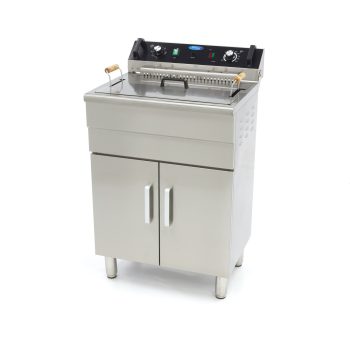 MaximaYou save 39%2-Year Warranty
Commercial Deep Fryer - 30 l - 1 Basket - with Drain Tap and Stand
-
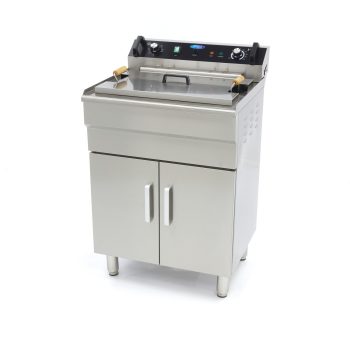 MaximaYou save 41%2-Year Warranty
Commercial Deep Fryer - 35 l - 1 Basket - with Drain Tap - 400 V
-
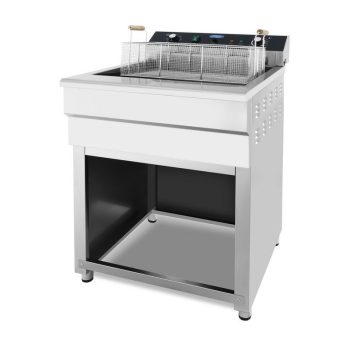 MaximaYou save 39%2-Year Warranty
Commercial Deep Fryer - 45 l - 1 Basket - with Drain Tap - 400 V
-
 MaximaYou save 40%2-Year Warranty
Commercial Deep Fryer - 2 x 16 l - 2 Baskets - with Drain Tap and Stand - 230V
-
 MaximaYou save 46%2-Year Warranty
Commercial Premium Fryer - 2 x 22 L - Double Unit - 90 cm Deep - Gas
-
 MaximaYou save 44%2-Year Warranty
Commercial Premium Fryer - 1 x 22 L - Single Unit - 90 cm Deep - Electric