
Note — This guide is intended for general orientation and does not replace individual professional planning. It is based on typified assumptions and does not take into account the spatial, technical, regulatory and operational conditions of your business. Before making a purchase or installation decision, have all specifications relating to safety, hygiene, fire protection, electrical installations and ventilation checked by a qualified professional, and observe the regulations applicable at your location. For the characteristics of a specific product, only the information on the relevant product page and individually agreed terms are authoritative.
If you process doughs, creams and batters daily in a commercial kitchen, bakery or catering operation, a domestic food mixer quickly reaches its limits. A professional planetary mixer is built for continuous commercial use: a large-capacity stainless steel bowl, a powerful motor and robust mechanics. With bowl sizes from 30 to 60 litres, our planetary mixers cover requirements from the foodservice operation to the production bakery.
Planetary mixer or spiral mixer – what is the difference?
In a planetary mixer, the attachment rotates on its own axis while simultaneously travelling in a circle around the bowl – hence the name. Every point in the bowl is reached. The big advantage: with interchangeable attachments – dough hook, flat beater and whisk – the machine is an all-rounder for yeast dough, cake batter, creams, fillings and whipped egg whites.
A spiral mixer, by contrast, is a specialist: designed exclusively for kneading dough and gentler with very large, firm batches of bread dough – but it will not whip cream or beat a custard. For operations that need a versatile machine for both patisserie and kitchen tasks, the planetary mixer is the right choice.
Which bowl size suits my operation?
The key distinction is between bowl capacity and maximum dough quantity – a bowl is never filled to the brim, because the attachment needs room:
- Planetary mixer 30 l – up to 15 kg of dough: the compact entry size for restaurants, cafés and smaller patisseries.
- Planetary mixer 40 l – up to 20 kg of dough: the middle ground for operations with regular in-house production, such as hotel kitchens or catering companies.
- Planetary mixer 60 l – up to 30 kg of dough: the industrial-grade size for bakeries and production kitchens with large daily batches.
Rule of thumb: plan around your largest regular batch, not the average.
3 speeds: what are they for?
The slow speed is intended for heavy doughs with the dough hook: yeast dough and bread dough need power at low revolutions, otherwise both motor and dough structure suffer. The medium speed suits cake batters, fillings and mixtures with the flat beater. The fast speed works air into the mixture with the whisk – for cream, whisked egg whites, sponge and light creams.
What to look for when buying: attachments, motor, day-to-day practicality
First, the attachment set: dough hook, flat beater and whisk are the core kit. Second, the motor rating: what matters is that the machine can handle its maximum dough quantity continuously, even at the slow speed. Third, cleaning: a removable stainless steel bowl and smooth surfaces save time every day. Fourth, the footprint: from 40 litres upwards we are talking about floor-standing machines with corresponding weight.
Below you will find our complete selection of planetary mixers.
More guides for your commercial kitchen
It is also worth a look at our guide to the prep kitchen and our guide to commercial spiral mixers.
Matching Products
-
 MaximaYou save 40%2-Year Warranty
Commercial Planetary Mixer - 10 l - Up to 5 kg Dough - 3 Speeds
-
 MaximaYou save 41%2-Year Warranty
Commercial Planetary Mixer - 20 l - Up to 10 kg Dough - 3 Speeds
-
 MaximaYou save 42%2-Year Warranty
Commercial Planetary Mixer - 30 l - Up to 15 kg Dough - 3 Speeds
-
 MaximaYou save 40%2-Year Warranty
Commercial Planetary Mixer - 40 l - Up to 20 kg Dough - 3 Speeds
-
 MaximaYou save 46%2-Year Warranty
Commercial Planetary Mixer - 60 l - Up to 30 kg Dough - 3 Speeds
-
 MaximaYou save 38%2-Year Warranty
Commercial Planetary Mixer - 7 l - Up to 2 kg Dough - Blue
-
 MaximaYou save 38%2-Year Warranty
Commercial Planetary Mixer - 7 l - Up to 2 kg Dough - Ivory
-
 MaximaYou save 38%2-Year Warranty
Commercial Planetary Mixer - 7 l - Up to 2 kg Dough - Lilac
-
 MaximaYou save 38%2-Year Warranty
Commercial Planetary Mixer - 7 l - Up to 2 kg Dough - Gold
-
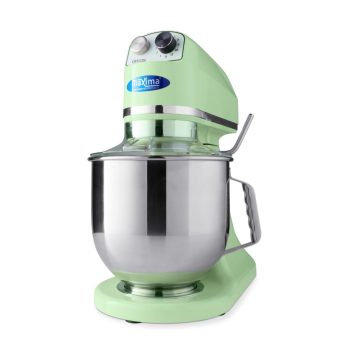 MaximaYou save 38%2-Year Warranty
Commercial Planetary Mixer - 7 l - Up to 2 kg Dough - Green
-
 MaximaYou save 38%2-Year Warranty
Commercial Planetary Mixer - 7 l - Up to 2 kg Dough - Pink
-
 MaximaYou save 38%2-Year Warranty
Commercial Planetary Mixer - 7 l - Up to 2 kg Dough - Raspberry Red
-
 MaximaYou save 38%2-Year Warranty
Commercial Planetary Mixer - 7 l - Up to 2 kg Dough - Black
-
 MaximaYou save 38%2-Year Warranty
Commercial Planetary Mixer - 7 l - Up to 2 kg Dough - Matte Black
-
 MaximaYou save 38%2-Year Warranty
Commercial Planetary Mixer - 7 l - Up to 2 kg Dough - Silver