

Note — This guide is intended for general orientation and does not replace individual professional planning. It is based on typified assumptions and does not take into account the spatial, technical, regulatory and operational conditions of your business. Before making a purchase or installation decision, have all specifications relating to safety, hygiene, fire protection, electrical installations and ventilation checked by a qualified professional, and observe the regulations applicable at your location. For the characteristics of a specific product, only the information on the relevant product page and individually agreed terms are authoritative.
Whether in a café, at a snack stand or in a catering operation: freshly baked waffles are among the best-margin products there are. A commercial waffle maker has to deliver far more than a domestic appliance – it runs for hours through peak trade, bakes waffle after waffle to consistent quality, and cleans up quickly at the end of the day.
Which waffle shape suits my concept? (Belgian, square, on a stick)
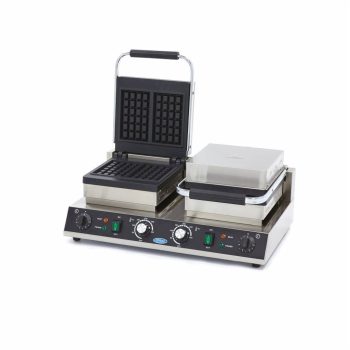
The shape of the waffle is not a matter of taste but a concept decision. The thick, airy Belgian waffle is the classic for cafés and breakfast trade: it is served on a plate. The "2 pieces – Belgian" unit bakes two at once and is the right base for table service. Square waffles, as produced by the "4 pieces – square" double unit, stack, cut and top well – practical for breakfast buffets, hotels and dessert menus. For street food, weekly markets and festivals, the waffle on a stick is the smartest solution: the "4 lollies – on sticks" unit produces waffle lollies that customers can eat on the move – no plate, no cutlery.
How many waffles at once?
A unit for two Belgian waffles is enough in a café where waffles are one item among several on the menu. If you run a stand where a queue forms at lunchtime, the maths are different: four waffles or four lollies per cycle halve the waiting time per customer – and at a market stall that is exactly what decides the day's takings. Double units offer the additional advantage that both baking plates can be used independently: one side is already baking while the other is refilled.
What to look for when buying (power, non-stick, cleaning)
First, the power: enough watts – around 1,500 W on the Belgian model – ensure the baking plates come back up to temperature quickly after opening; in continuous operation that is the difference between golden-brown waffles and pale results from the tenth round onwards. Second, the non-stick coating: it decides whether waffles release cleanly. Third, cleaning: smooth surfaces and accessible baking plates save time – check whether a model comes with or without a drip tray. Also look for a stable stand and heat-resistant handles – in a busy operation that is workplace safety.
You will find the right professional waffle makers below in our overview.
More guides for your commercial kitchen
It is also worth a look at our guide to cooking equipment and our guide to buffet & catering.
Matching Products
-
 MaximaYou save 38%2-Year Warranty
Commercial Waffle Maker - 1 Piece - Ice Cream Cones
-
 MaximaYou save 37%2-Year Warranty
Commercial Waffle Maker - 1 Piece - Stroopwafel
-
 MaximaYou save 37%2-Year Warranty
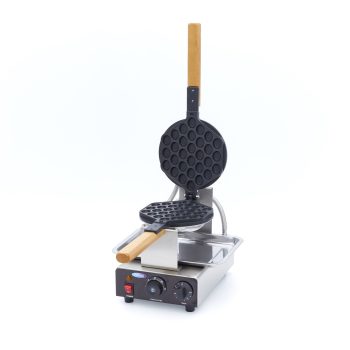
Commercial Waffle Maker - 1 Piece - Bubble Pattern
-
 MaximaYou save 37%2-Year Warranty
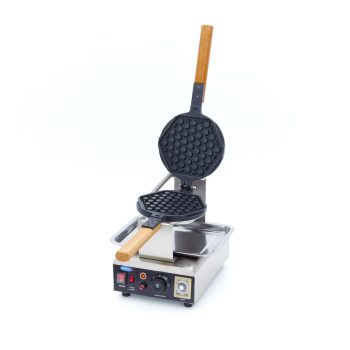
Commercial Waffle Maker - 1 Waffle - Round Honeycomb Pattern
-
 MaximaYou save 37%2-Year Warranty
Commercial Waffle Maker - 10 Pieces - Churros
-
 MaximaYou save 37%2-Year Warranty
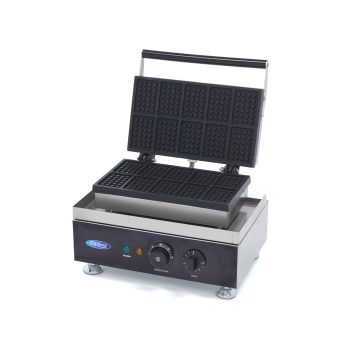
Commercial Waffle Maker - 10 Waffles - Mini Belgian
-
 MaximaYou save 37%2-Year Warranty
Commercial Waffle Maker - 2 Pieces - Ice Cream Cones
-
 MaximaYou save 37%2-Year Warranty
Commercial Waffle Maker - 2 Pieces - Rotating - Digital
-
 MaximaYou save 37%2-Year Warranty
Commercial Waffle Maker - 3 Lollies - Emojis on Sticks
-
 MaximaYou save 37%2-Year Warranty
Commercial Waffle Maker - 3 Lollies - Hearts with Emojis on Sticks
-
 MaximaYou save 37%2-Year Warranty
Commercial Waffle Maker - 3 Pieces - Belgian
-
 MaximaYou save 38%2-Year Warranty
Commercial Waffle Maker - 3 Pieces - Vagina - Rotatable
-
 MaximaYou save 37%2-Year Warranty
Commercial Waffle Maker - 4 Lollies - on Sticks
-
 MaximaYou save 37%2-Year Warranty
Commercial Waffle Maker - 4 Pieces - Square - Double
-
 MaximaYou save 39%2-Year Warranty
Commercial Waffle Maker - 4 Pieces - Hearts on Sticks