

Note — This guide is intended for general orientation and does not replace individual professional planning. It is based on typified assumptions and does not take into account the spatial, technical, regulatory and operational conditions of your business. Before making a purchase or installation decision, have all specifications relating to safety, hygiene, fire protection, electrical installations and ventilation checked by a qualified professional, and observe the regulations applicable at your location. For the characteristics of a specific product, only the information on the relevant product page and individually agreed terms are authoritative.
A refrigerated counter for the professional kitchen does two jobs at once: it keeps ingredients chilled within reach at working height and provides a robust worktop at the same time. In a commercial kitchen it replaces the constant walk to the cold room and noticeably shortens the distances covered during mise en place.
Which length and how many doors suit your prep area?
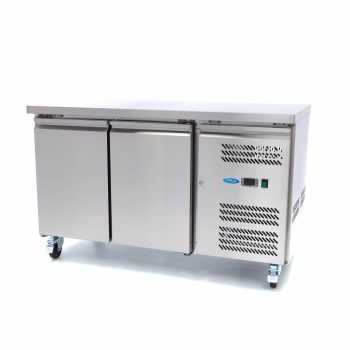
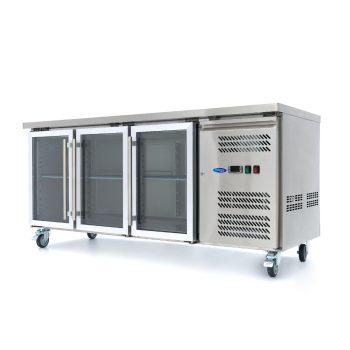
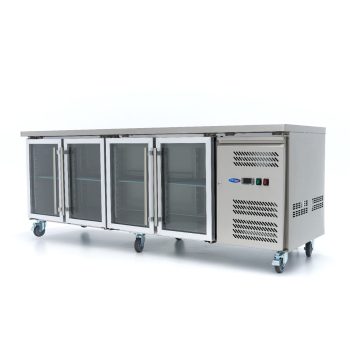
With every additional door width, the counter grows by around 45 to 50 centimetres. A compact refrigerated counter at 90 cm with 2 doors suits small kitchens, food trucks, or works as a supplementary station at the pass. If you are planning a fully-fledged prep line, go for the mid-range class: 180 cm with 3 doors offers space for a complete station set-up. At the top end sits the refrigerated counter at 223 cm with 4 glass doors – here two chefs work side by side. Glass doors have a practical advantage: the contents are visible at a glance, the door stays open for less time, and the refrigeration unit has less catching up to do.
Doors or drawers?
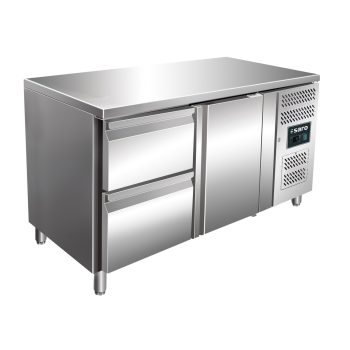
Doors open up the full interior and also take bulky containers or whole trays. A refrigerated counter with drawers plays to its strengths when organising GN containers: every drawer is a permanently assigned slot – the chef pulls it out and has the container right in front of them, without bending down. Especially at high-tempo stations (salad station, pizza toppings, à la carte prep), drawers are often the more efficient choice. This configuration is also available as a freezer counter with drawers.
Refrigerated counter or freezer counter – what is the difference?
The build is identical; the temperature range is not. A refrigerated counter keeps ingredients fresh at above-zero temperatures – ideal for everything processed the same day. A freezer counter operates below zero and stores goods permanently frozen, directly under the worktop. That pays off wherever frozen components are a fixed part of the menu: bake-off pastry blanks, chips, ice-cream components. A freezer unit delivers more cooling power but also gives off more waste heat – plan the installation site accordingly.
What to look for when buying: worktop and installation dimensions
First, the worktop: in the commercial kitchen, stainless steel is the standard – low-seam, impact-resistant and easy to clean to HACCP standards; an upstand protects the wall. Second, the installation dimensions: measure not only the footprint width but also door clearances along the delivery route and the swing radius of the open doors. Third, ventilation: the refrigeration unit needs air circulation – a refrigerated counter does not belong hard up against a cooker or fryer. Fourth, the internal organisation: check whether the interior matches your GN container sizes.
Below you will find our complete range of refrigerated and freezer counters.
More guides for your commercial kitchen
It is also worth a look at our guide to refrigeration equipment and our guide to the prep kitchen.
Matching Products
-
 MaximaYou save 41%2-Year Warranty
Commercial Refrigerated Counter - 136 cm - 2 Glass Doors
-
 MaximaYou save 39%2-Year Warranty
Commercial Refrigerated Counter - 136 cm - 2 Doors
-
 MaximaYou save 39%2-Year Warranty
Commercial Refrigerated Counter - 137 cm - 3 Doors
-
 MaximaYou save 44%2-Year Warranty
Commercial Refrigerated Counter - 180 cm - 3 Glass Doors
-
 MaximaYou save 42%2-Year Warranty
Commercial Refrigerated Counter - 180 cm - 3 Doors
-
 MaximaYou save 40%2-Year Warranty
Commercial Refrigerated Counter - 223 cm - 4 Glass Doors
-
 MaximaYou save 41%2-Year Warranty
Commercial Refrigerated Counter - 223 cm - 4 Doors
-
 MaximaYou save 39%2-Year Warranty
Commercial Refrigerated Counter - 90 cm - 2 Doors
-
 SaroYou save 35%
SARO cooling table, 2 doors, VIVIA S 901 S/S TOP PRO
-
 SaroYou save 35%
SARO cooling table,door + 3x 2-drawer set,KYLJA 4160 TN
-
 SaroYou save 35%
SARO cooling table,door + 2-drawer set, KYLJA 2110 TN
-
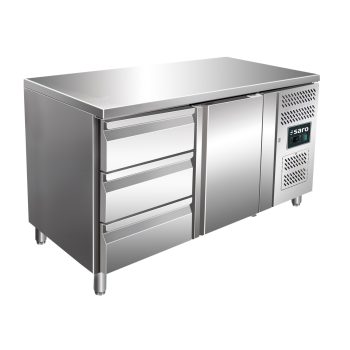 SaroYou save 35%
SARO cooling table, door + 3-drawer set, KYLJA 2130 TN
-
 SaroYou save 35%
SARO cooling table,door + 2x 2-drawer set,KYLJA 3140 TN
-
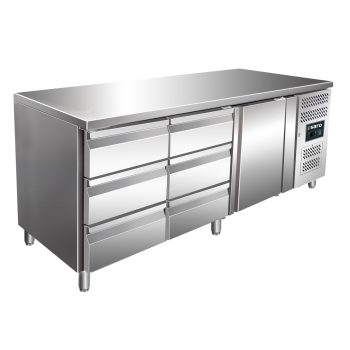 SaroYou save 35%
SARO cooling table,door + 2x 3-drawer set,KYLJA 3150 TN
-
 SaroYou save 35%
SARO Cooling table with 1 door, model VIVIA S 401